Key Takeaways
- Watering, mowing, and timing mistakes cause most of the lawn damage we see across Colorado, and all three are yours to fix without paying anyone.
- Call a professional when the damage spreads after you have corrected your watering, when the grass lifts away without roots, or when the fix has a deadline you have already missed.
- Greenlawn Sod & Turf grows and installs sod built for Colorado conditions, with a free on-site assessment before we recommend anything.
What Do Lawn DIYers Get Wrong Most Often?
The most common mistake is treating brown grass as a water problem before confirming that it is one. Adding water to a lawn that is not thirsty makes several Colorado problems worse.
Every July, we hear from homeowners who have already spent three months on a brown patch. They watered longer, put down fertilizer, then bought a bag of something off the hardware store shelf. The patch got bigger.
Almost none of those calls involve a bad product. They involve a bad diagnosis. That guess costs a season.
The line between a job you should do yourself and a job worth paying for is not difficult. It is whether you can tell what you are looking at.
Colorado State University Extension reports that lawn problems are the number-one concern brought to many of its county offices, Larimer included. These are the errors we see repeat across Front Range yards:
- Water more when the lawn browns. On a lawn carrying necrotic ring spot, extra irrigation feeds the fungus instead of the grass.
- Mowing short in midsummer. Short grass grows short roots, which is the opposite of what a stressed lawn needs in August.
- Loading on spring nitrogen. Fast-release fertilizer in May pushes soft top growth right as root diseases get established.
- Spraying before identifying the pest. Most retail insecticides kill only surface-feeding adults. They do nothing to larvae underground.
- Waiting until the damage looks obvious. Once a patch is clearly dead, the treatment window has usually closed.
Four of those five are timing errors rather than effort errors. That is how a lawn declines while its owner works hard on it.

Colorado's Sod Farm Since 1969
Premium natural sod & artificial turf, harvested daily and delivered across the entire Front Range. Residential, commercial, and contractor pricing available.

Which Lawn Problems Can You Fix Yourself?
Most of them. Most of what goes wrong in a Colorado yard is a maintenance issue with a straightforward fix, and paying someone for it is money you do not need to spend.
Handle these yourself:
- Uneven color across the yard. Set empty tuna cans out, run a normal cycle, then measure. Uneven water in the cans means uneven coverage, not disease.
- Ragged, bleached blade tips. That is a dull mower blade. Sharpen it.
- Grass thinning under a maturing tree. Shade tolerance is a grass-selection problem, and this could be remedied by matching grass type to sun and shade.
- Scattered broadleaf weeds. Pull them or spot-treat. A dense, correctly mowed lawn crowds out most of them.
- New sod that looks rough early on. Settling seams, curling edges, and slow green-up are normal establishment behaviors.
Before anything else, fix your mowing height. Raising the deck is the cheapest improvement available to a Colorado lawn, and our summer mowing guide covers the height and frequency that hold up through the heat.
How Can You Tell Drought Stress From a Real Problem?
Run three checks that take about ten minutes and need no equipment. They separate a thirsty lawn from a damaged one, which is the decision that the rest of your season depends on.
The footprint test. Walk across the brown area in the evening. If your footprints stay visible for more than a few minutes, the grass has lost the water pressure it needs to spring back.
The tug test. Grab a handful of brown grass at the base and pull straight up. Healthy roots resist. Grass damaged by billbugs breaks off at the crown, and CSU notes the larvae leave a sawdust-like residue at the base. Grass that lifts in a mat with no roots points to grubs instead.
The soak test. Give one brown area a measured, deep soak, then leave it alone for a week. Drought-stressed grass responds. Grass with dead roots cannot respond, no matter how much water you add.
That third test matters most. A lawn that fails is telling you the problem is below ground, which is where guessing gets expensive.
7 Common Problems With New Sod That Slow Down Establishment
When Should You Call for Professional Lawn Care Instead?
Call when the problem has a deadline, a diagnosis you cannot confirm, or a treatment you cannot legally buy. Those three cover nearly every case where DIY effort becomes a lost season.
| What you are seeing | Likely cause | Who should handle it |
|---|---|---|
| Uneven green-up, dry streaks | Sprinkler coverage | You |
| Brown that recovers after a deep soak | Drought stress | You |
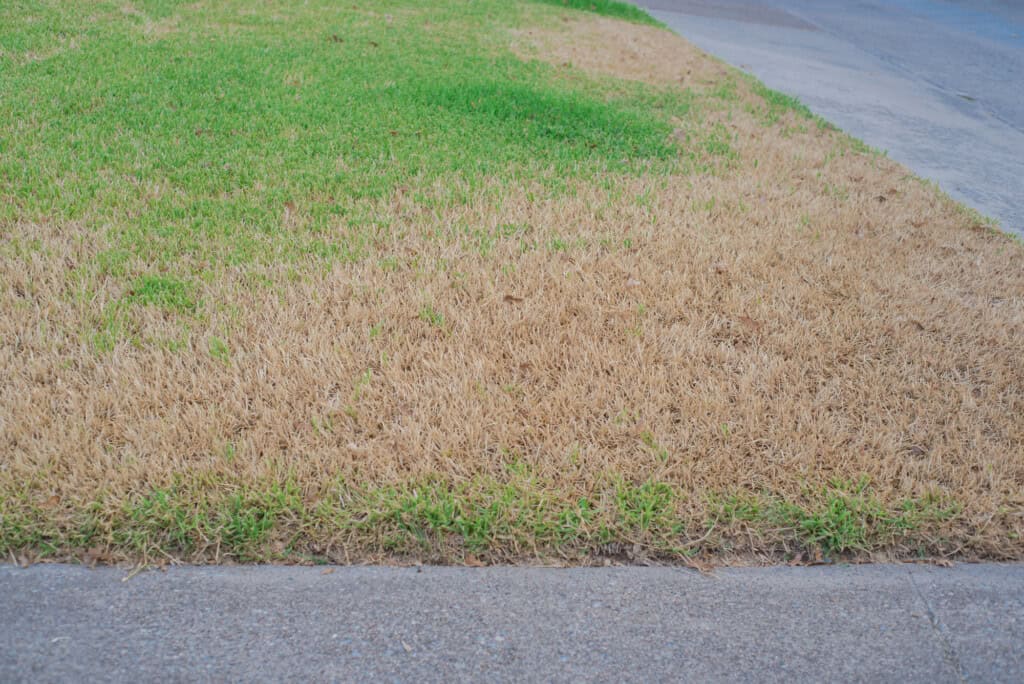
| Straw-colored rings or arcs, green centers | Necrotic ring spot or summer patch | Professional |
| Patches that lift like a carpet, no roots | Billbugs or white grubs | Professional |
| Water pooling in the same low spot | Grading or drainage | Professional |
| More than half the yard failed | Established lawn is finished | Professional |
Three specifics matter here.
Rings and arcs are genuinely hard to identify. Necrotic ring spot is the most destructive disease of Kentucky bluegrass in Colorado, and CSU notes that a related disease, summer patch, mimics it closely. Lab confirmation is sometimes the only way to tell them apart. The fungicides that work on it are also largely not sold at retail, so they reach lawns through licensed applicators.
The instinct to water a diseased lawn harder is the one to fight. CSU’s guidance is direct: “Do not overwater. This is perhaps the most important prevention practice.”
Insect treatments have narrow windows. CSU’s billbug guidance puts effective adult control in early May for bluegrass billbugs and early to mid June for the Rocky Mountain billbug, the more common species here. Spray in August, when damage finally looks alarming, and you are treating an insect that has already finished feeding.
Some products are no longer yours to buy. Since July 2024, Colorado has classified most neonicotinoid pesticides as limited-use, so only licensed dealers can sell them. If a diagnosis points to one of those, the decision is made for you.
For a second opinion with no sales pitch attached, CSU Extension’s Lawncheck program offers fee-based diagnosis in Larimer, Weld, and other Front Range counties.
When Is a Lawn Too Far Gone to Repair?
When more than half of it is weeds, bare soil, or dead grass, repair stops being the cheaper option. Below that threshold, targeted fixes usually work. Above it, you are paying to maintain a lawn that has already failed.
The other signal is repetition. If the same patches return in the same places every summer despite correct watering and mowing, the problem is in the soil rather than the grass. Compaction, poor grading, and soil-borne disease all behave that way, and none can be fixed from the surface.
That is what a yard renovation addresses. The old turf comes out, the soil gets tilled, amended, and regraded, then new sod goes down on ground that will support it. CSU’s necrotic ring spot guidance points the same way, recommending compost worked into the soil before sod goes down on a problem site.
How Greenlawn Sod & Turf Handles Lawns That Are Past a DIY Fix
We have grown sod in Northern Colorado since 1969, which means we have watched the same handful of problems move through the same neighborhoods for over fifty years. That history is why our first answer is often that you do not need us yet.
Every job starts with a free on-site assessment. We measure the yard, check the soil, and tell you whether you need a repair, a partial replacement, or a full renovation. If most of your grass is healthy, we say so, and we replace only the problem areas.
Our sod is state-inspected and certified by the Colorado Department of Agriculture, grown for Colorado soil, water limits, and sun. Grading, compaction, and drainage get handled during installation, because a lawn laid over an unfixed problem fails the way the last one did.
We serve Fort Collins, Loveland, Greeley, Windsor, Boulder, and up to Cheyenne, with pickup and delivery from two Colorado yards.
What to Do Next
Work through the decision in order and stop as soon as one step solves it. Most homeowners never get past the second bullet.
- Run the three checks on your worst patch. Footprint, tug, and a measured soak, then wait a week before buying anything.
- Fix your watering and mowing first. Deep, infrequent irrigation and a sharp blade at a raised height resolve more Colorado lawn complaints than any product will.
- If the damage is still spreading, bring us in. Request a free quote or call (970) 482-6574, or visit us at 2524 NE Frontage Road in Fort Collins. We will tell you what the yard actually needs, even when that turns out to be nothing.
Frequently Asked Questions
Is professional lawn care worth it for a small yard?
It depends on the problem, not the square footage. Mowing, watering, and weed control stay cost-effective as DIY work at any size. Diagnosis and soil correction are worth paying for even on a small yard, because a lawn that fails twice costs more than getting it right once.
Can I just put new sod over a lawn that keeps dying?
Not if the cause is still in the ground. Compaction, drainage problems, and soil-borne disease will hit new sod the same way they hit the old lawn. The soil work is what makes the second attempt different from the first.
How much of my lawn has to be dead before I replace it?
Roughly half. If more than half the yard is weeds, bare soil, or dead grass, a full renovation is usually cheaper than another season of patching. Under that, targeted replacement of the failed sections makes more sense.
Why does my grass turn brown even though I water it every day?
Daily watering is often the cause rather than the cure. Frequent shallow watering keeps roots near the hot surface and encourages several Colorado turf diseases. Deep watering, no more than a couple of times a week, produces a lawn that handles August better.
Who do I call to diagnose a lawn problem in Colorado?
Start with your county CSU Extension office, which gives unbiased diagnoses and sells nothing. For problems that trace back to soil, grading, or turf that has already failed, a sod grower who does the soil work is the better call.